Mairi Crawford — Roman Jewelry

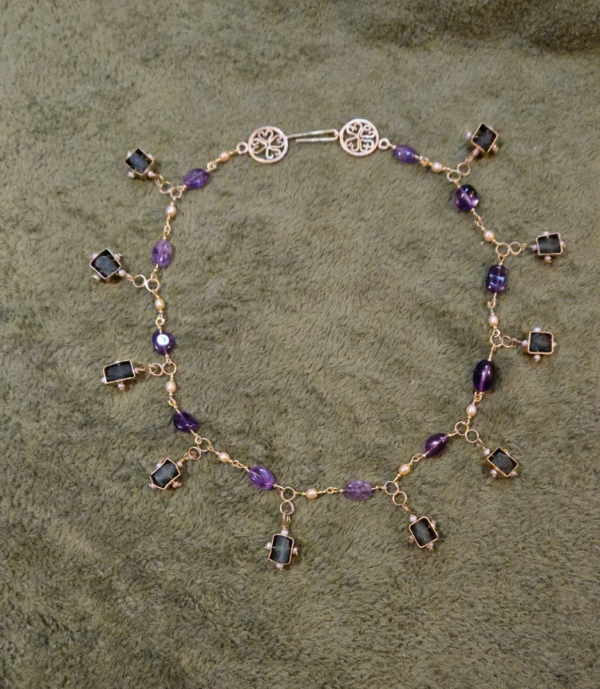
I found this necklace in the Worcester Art Museum and needed to make it. I practice the skills I would need to create this piece. It is Roman from the Byzantine Empire Cyprus. 

Additional Documentation is available on my blog: https://mairicrawfordsart.wordpress.com/2025/02/26/roman-necklace-for-as-champs-march-1-2025/

Ciaran ua Meic Thire — Ise Katagami Tiger

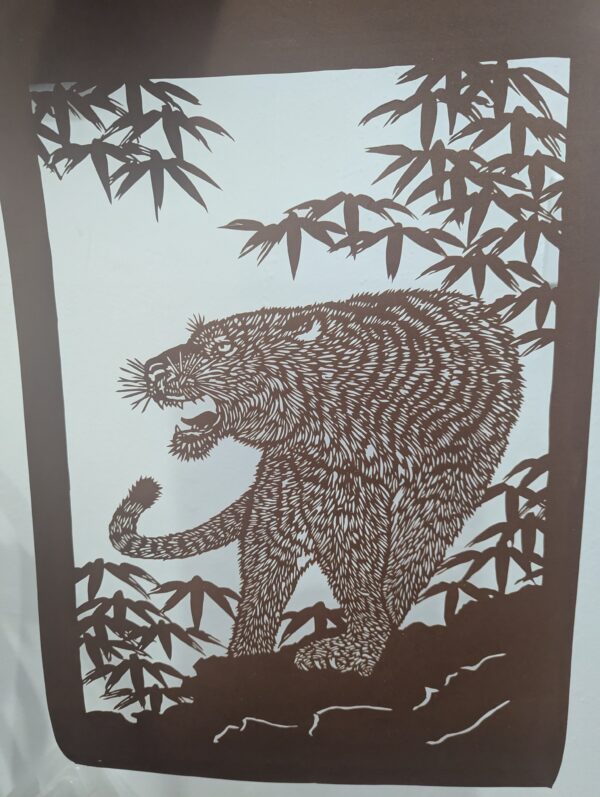
As the invention of paper spread across the world, so too did many cultures discover that paint or pen are not the only way to make art with paper. Within a few hundred years of paper being first brought to Japan in the 8th century CE, three distinct papercut arts emerged: kirigami which involves folding, cutting and then unfolding of the paper (see? paper snowflakes are period!), kamikiri which was a performance art of creating a papercut with music and audience participation, and katagami which was the art of making stencils that would be used in katazome to dye fabrics. The earliest evidence of katagami found was from the Kamakura period (12-14th century CE) and was practiced through the Edo period that began at very beginning of the 16th century to the industrial revolution of Japan in the 19th century. The piece cut here is based on an extant piece from the Edo period (the few extant pieces that exist from pre-Edo tend to be much simpler, most likely because more intricate pieces deteriorated at a faster rate) and is the first time I was able to do so with not only the period techniques but also the period materials as well. For reference, this piece measures about 11″x15.”

Ise Katagami uses a special kind of paper known as shibugami which is made by layering washi paper that is soaked with fermented persimmon juice called kakishibu then dried in then and smoked for seven to ten days. The process would be repeated several times over a period of about 6 months to create a paper that was very tough but also non-absorbent so that it could be used multiple times in stencil dying. Cut on a bamboo cutting board, there were three main styles of creating designs: tsukibori (push carving with a knife), kiribori (drill carving with a semi-circular blade), and dogubori (punch carving using shaped punches). This piece was done in the style of tsukibori using a kiridashi knife which has a small triangular blade sandwiches between two pieces of bamboo that were wrapped together. In period, the design would be drawn on a single sheet of washi paper and then adhered to the shibugami using a rice glue while I used scotch tape instead. Overall, this piece took about 80 hours to cut and I found that while there was no discernable difference in cutting on a bamboo cutting board versus a modern cutting mat or between shibugami and a thicker paper such as cardstock or perg, the kiridashi knife was significantly better for cutting than a modern x-acto blade. I usually have to change x-acto blades 2-3 times minimum for a project of this size because they become duller but with the kiridashi, I did not even need to resharpen it through this project. In fact, through cutting this project and another of equal size and intricacy, the blade is still as sharp as a new x-acto blade with no signs of dulling at all! I am very excited to finally be able to work with the shibugami paper and kiridashi knife both from Japan using traditional techniques and continue my search for extant designs in katagami but also in the other dozen plus period papercut arts from around the world. For additional information about this project and others, please check out my blog through the attached link. More posts to come. If you ever would like to learn more and/or give papercut arts a try, feel free to reach out. Just remember, no matter how difficult a piece looks to cut, it all comes down to just straight lines, curved lines and circles and that you’re already a period papercut artist if you’ve ever made paper snowflakes!

Adelisa Salernitana — Arabic-Sicilian Scaf Dance

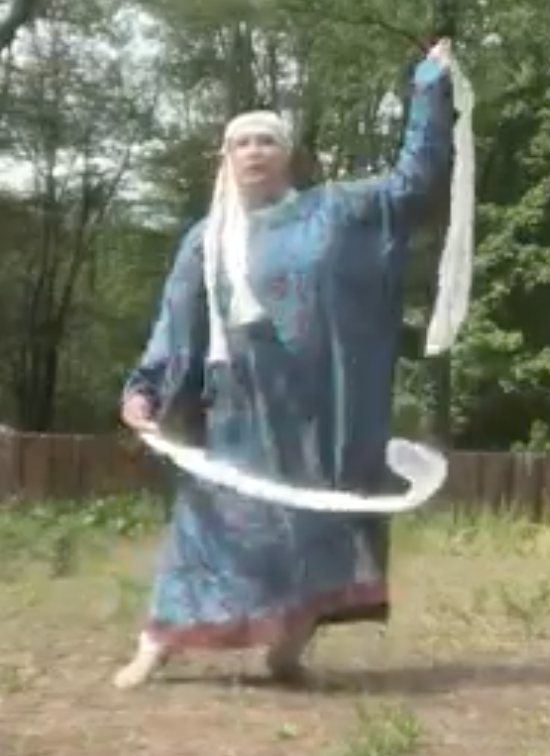
In the First Bardic War, an online event in May 2021, I entered the Non-European dance category with my recreation of a scarf dance as depicted on the muqarnas ceiling of the Cappella Palatina in Palermo. Scarf dancers were a stock image of the muqarnas ceilings and frescoes of 12th century Muslim Middle East and Mediterranean, along with musicians, drinkers, hunters, and wrestlers. For the garb, I chose to go with a richly figured silk tunic and white linen underpinnings. Everything was handsewn by me. The silk, a very lightweight woven jacquard, came from a vintage silk sari. The trim at the bottom, a heavy woven band of silk, came from another sari. The collar trim, which was woven with metal threads, came from the pallu of the jacquard sari. The pattern of the sari, a scrolling foliate, is not too dissimilar from some of the patterns of the material depicted in the Cappella Palatina muqarnas.

For the dance, I have looked at the images and I chose moves that are reminiscent of how the dancers are depicted. There are no extant choreographies from the period to refer to. There are modern Andalusian scarf dances from North Africa, and I have referred to some long-ago lessons with Amel Tafsout. For arm movements, I referred to my experience with Persian dance taught by Dr. Laurel Victoria Gray and Autumn Ward. I had done Middle Eastern dance for approximately 20 years at this point, from Egyptian cabaret (with Habiba of Philadelphia), ATS, Turkish (workshops with Artemis Mourat and others), and fusion. There is little agreement in the bellydance world where certain moves originated, and until Jamila Salimpour started codifying moves in a ballet-style system starting in the 1940s and ’70s and started teaching her system, there was no “official” technique and certainly nothing to indicate how moves were done in the medieval past. For me, I let the costume, the technique I managed to learn, and the music dictate the way I moved. 

The music posed another challenge, as there is no extant 12th century Arab Sicilian music. Indeed, the earliest documented Arabic song still used by dancers today is the muwashshah “Lama bada yatathanna” (the poem is thought to have been composed in period, but the music we know today may have been composed in the 1920s). But many Arabs in Sicily wound up emigrating to Andalusian Spain after the Normans conquered the island, and their descendants emigrated from there to North Africa after the expulsion by Ferdinand and Isabella. However, the trading families had communications with kin in North Africa all throughout period. This gives the Andalusian music of North Africa very deep roots, and some of the nubat (orchestral pieces, singular, nuba) can be traced to within the medieval period. The main problem is most nubat are about an hour in length in full performance, and most excerpts from these nubat are about 15 minutes or so. Enter the group Calamus, and their 1995 recording “The Splendour of Al-Andalus.” Track 10 yields a piece called “Quddam,” an excerpt from a nuba from Morocco. It’s a sprightly 6/8 rhythm, and easy enough to dance to. I hope all the elements give the viewer an idea of what medieval “Middle Eastern” dance in Sicily could have been like.

YouTube link: https://www.youtube.com/watch?v=GiAkJac3KOE
Lillian Hutchinson — The Color of Desire

The vermillion flash of Louboutins, the cherry sports car, the oxblood satchel propped on the conference table- since the dawn of time, ruling classes have found ways to telegraph power and prestige. And in medieval Europe the most striking way was the color red. Of all the rainbow of hues in the dyer’s palate, red was the most costly. So, when Spaniards encountered a brilliant crimson dye in the marketplaces of the Aztec civilization, the stage was set for cochineal to become one of the most valuable commodities in the world. 

The benefits of cochineal were truly global. For dyers, it represented a revolution in production. Faster, more effective, and more prevalent, cochineal could produce a monochromatic palate from pale pink to crimson- even a hot pink that would make the 1980s jealous. For farmers in Mexico, cochineal represented a source of income and a way to preserve their cultural heritage. And for the rest of the world, cochineal became one of the most prized commodities in the global economy.

Additional Documentation: https://docs.google.com/document/d/12UgmCYAl5LQsBjJKtoMQG8IHKjY2n33X/edit?usp=drive_link&ouid=103849751791663771298&rtpof=true&sd=true

Proudly powered by WordPress | Theme: Baskerville 2 by Anders Noren.

Up ↑