A&S Champs 2025 FAQ

With A&S champs now on the East Kingdom Event Calendar, I wanted to take a moment to address some common questions that come up often concerning this competition. If you have a question that isn’t addressed below, please feel free to email me at moas@eastkingdom.org.

-Amalie

Q: When and where is A&S champs this year?

A: The A&S Championship Competition will be held on March 1st, 2025, in the Barony of Settmour Swamp (Washington, NJ). You can find the event listing here: https://www.eastkingdom.org/event-details/?eid=4362 

Q: How do I sign up to compete, judge, or display?

A: Registration for competitors, judges, and display entrants opens on December 1st, 2024. On December 1st, the registration links for all three of those options will go live on the MoAS website, which can be found here: https://moas.eastkingdom.org/crowns-as-champions/. Please note that the registration deadlines differ based on your project. Research projects and projects that will be judged remotely have an earlier registration AND documentation deadline. 

Q: Who can enter the competition?

A: Anyone! You do not need to have reached a certain “level” in the A&S awards system.That being said, this is a high level competition, so beginners may want to try out more local competitions before entering the Kingdom Championship competition. 

Q: Who can be a judge? Do I need to have a certain level of A&S award to be a champs judge?

A: You do not need to have any A&S awards to serve as a judge. However, this year, we *will* be prioritizing judges who have completed our Judge Certification Program. To become a certified judge, you need to attend an A&S rubric training session and a Consent in A&S class, which can be done online or in person. If you are interested in judging and are not yet a certified judge, there’s still plenty of time to complete that process! For more information on Judge Certification, visit https://moas.eastkingdom.org/judge-certification-program/ 

Q: Will you be holding rubric training classes for artisans and judges prior to the competition?

A: Yes! Be on the lookout for upcoming classes. Live classes will be held at St. Eligius and Birka, with additional live classes possible at other events. There will also be two online classes held in early 2025. 

Q: Will there be a remote option for competitors who cannot attend the event due to accessibility concerns?

A: Yes, there is a remote option to accommodate accessibility needs. Artisans who request to be judged online will meet with their judges via video conferencing the week before the live event. They also have earlier registration and documentation deadlines.

Q: This is a dry site. Does this mean brewers can’t enter?

A: Brewers can still enter! We are working on several potential workarounds, and will have more information on the brewing situation in the coming weeks. In the meantime, anyone interested in competing with an alcoholic brewing entry should contact the KMoAS at moas@eastkingdom.org. 

Q: How recent does my entry need to be? Can I enter a project I made several years ago? Can I enter a project that I’ve used before for A&S champs?

A: Projects to be judged should have been completed within four years of the competition. But note that it could’ve been started years earlier! Entries may have been entered into (and even won) local/regional A&S competitions. However, no item should have won a previous Kingdom Championship competition. If a project has been entered in a previous year’s East Kingdom A&S Championship, it must have substantial revision and new material in order to be submitted again.

Q: What is the role of the A&S Champion?

A: The duties of the A&S champions include representing the Crown at events, participating in and/or assisting with the Pennsic A&S War Point, and assisting the MoAS office in running next year’s Crown’s A&S. Please note that attendance at Pennsic, while strongly encouraged, is not required.

Basic A&S Score Sheet Ready for Beta Testing
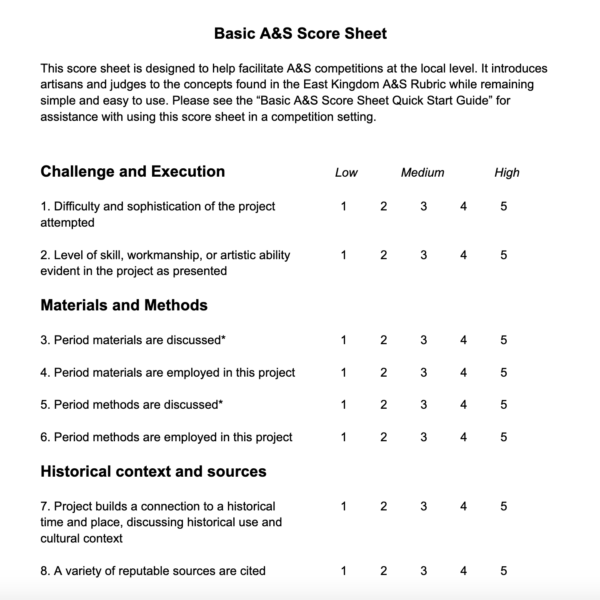
Over the past few months, the MoAS team has been working on creating a resource intended to help local groups run A&S competitions: The Basic A&S Score Sheet. This one-page resource introduces the concepts found in the East Kingdom Rubric on a less intense, more pared-down scale to make it approachable for beginner artisans, while maintaining the core components to allow more experienced artisans to enjoy using it as well. The scoresheet comes with a one-page “quickstart guide” to help artisans and judges understand quickly how to use the elements of this scoresheet.

The MoAS team has finished our final round of editing, and the scoresheet is now available for beta testing! Use the link below to find the beta-testing version of the A&S scoresheet: 

https://drive.google.com/file/d/1Ar_aXgBvRTP3PnpvI7cST2e9igJzxgni/view?usp=sharing

If you use this for your local group’s competition, please let the Kingdom MoAS minister know how it goes! All commentary, both positive and critical, is very helpful as we work to refine this resource. You can contact the KMoAS at moas@eastkingdom.org.

In service,

Amalie
EK MoAS

A Day of A&S Challenges at Harper’s Retreat: List of Challenges
The East Kingdom Ministry of Arts and Sciences is excited to announce our list of A&S challenges for A Day of A&S Challenges on September 14th at Harper’s Retreat! The challenges at this event are being hosted by a variety of artisans at different stages of their A&S journeys, so you will find challenges being offered by newer artisans all the way up to laurels. The goal of these challenges is to begin conversations between artisans in the A&S community to help build community and relationships. This is NOT a competition, and all levels of artisans are welcome to participate!

Participants may choose to enter as many challenges as they choose, and may display other work along with challenge entries. Each challenger has defined the terms of their challenge, so please read them carefully. Participants will meet with the artisan issuing the challenge live at the event. If you have questions regarding a challenge, please contact the kingdom minister of A&S at moas@eastkingdom.org.

Since Harper’s Retreat is, at its heart, a bardic event, several of these challenges include a performance option along with another discipline. Where this applies, those challenges have been listed twice – once under performance, and once under the other discipline of the challenge. There will be a designated time for performances during the day of challenges, which is TBD at the moment. Stay tuned for more details soon!

We also have two special categories of challenges this year: challenges presented by the East Kingdom Arts and Sciences Champions, and challenges for youth, presented by the Chancellor Minor of the Barony of Stonemarche. Please note that the youth challenges have a separate registration form, due to Society policy stating that a parent must be cced on all communications involving youth.

Please note that this is an in-person event and requires advance registration. The display will take place in the feast hall location at the Harper’s event site from 10-4 on Saturday, September 14th.

The deadline to register for challenges or display entries is September 3rd at 11:59 pm.

To register for a challenge or display entry, click here.

To register for a youth challenge, please use this link.

As always, if you have any questions or concerns regarding these challenges, please contact the kingdom minister of A&S at moas@eastkingdom.org.

General Arts (not art specific)

Largesse Challenge, Solveig Bjarnardottir

Giving your art is a selfless act. Giving it with the knowledge that the recipient may never know it’s from you is a greater act. I challenge you to make largesse to be donated to the kingdom in honor of Their Royal Highnesses.

Advanced Art Challenge, Audrye Beneyt

Take a project you did early on in your learning, and remake it. For example, take one of your first scrolls and do it again with all the new techniques you’ve learned since the first time. Show me the old project (this can be in photos) and show me the Mk 2 project. Tell me about the differences and how you feel about your art journey. The project can absolutely be in progress, and does not need to be fully completed

A Challenge for Laurels, Amalie von Hohensee

This is a challenge for laurels! It can be hard to find motivation to do your own work on your passion projects after elevation, so this challenge is intended to create a space for laurels to display their work. You may display work that you did to receive your laurel, or any work done after your elevation.

Champions’ Challenges – Presented by the East Kingdom A&S Champions

It takes a village, Charis Accipiter, Consort’s Champion of A&S

For this challenge, more than one person must have worked toward the final goal. Artisans in period would have worked with others, cooks needed cookware, bookbinders needed parchment, and actors needed props and costumes. I challenge you all to collaborate with fellow artisans. Find new ways to work together to elevate each other’s art to the next level. There are no restrictions for what type of art or science you enter but two or more people will need to combine their different talents to produce a cohesive entry. If you are a brewer, maybe you work with a potter to produce a period drinking vessel or bottle. Maybe you wish to create a period outfit as a seamstress, but someone else weaves the trim or creates the jewelry accessories. Are you a bard? Work with a musician who can accompany your new song or tale on a period instrument. The possibilities are endless!

Your final entry should be one cohesive project but may consist of multiple items as long as they work together. They can not just be two disparate things that may have come from the same time period or location. (For example a painting and a dress – this would work if the dress was what the artist was using as a reference in the painting. It would NOT work if the dress and the painting both just came from 16 th century Italy)

Some documentation of what time and place your entry is representing is requested. Works in progress are welcome as long as all artisans who are collaborating have some work toward the final project to show. (There may be a part two coming later in the year.

That’s So Metal! Nathan Hartman, Sovereign’s Champion of A&S

For this challenge, artisans are asked to recreate a historically plausible item made from metal. Any sort of metalwork is acceptable, from forged blades, to household goods, to jewelry and everything in between. Although period techniques are encouraged, modern tools and techniques are acceptable. Documentation and research is encouraged, but there is no documentation requirement for this challenge. At a minimum, please provide some evidence (a photo, or a description from a source) showing your item, or something like it, existing historically.

Research

Don’t Make, Research Instead! Lissa Underhill

This could be anything – an object, a craft, a person, an event, whatever you are interested in. Information may be presented however you like, written, poster, oral presentation. However, I encourage you to really spend time looking for and using a good variety and type of sources. Need help. Just ask! I’m a Librarian- we can research together!

Challenging Research Challenge, Collette d’Avignon

Tell me about the biggest obstacle you have overcome in the last year of your research.

Persona

Persona Perfect, Aurelia Colleoni a’Buccafurno

We challenge you to present something that would have been used or made by your persona. Written documentation is not required, but we would like to know why you chose your project, how you went about making it, and how it relates to your persona. All projects are welcome, including those still in progress.

Out of a Painting, Collette d’Avignon

Create something to use in your medieval home that you see in a painting from period.

Experimental Archeology

Experimentation Challenge, Lissa Underhill

Sometimes we don’t have all the information about how something was made, how a tool was used, how something was worn historically, etc. Take a bit of time to experiment with a few options, and be prepared to tell the story of what you learned from your explorations. Talk about where you got your different ideas from, and how your experiences with each method differed and stayed the same, and what you learned. The focus of your experiments should be narrow, focused on one idea. You can compare historic and modern ideas, or multiple historic ideas

Performance

“If music be the food of love, play on,” Solveig Bjarnardottir

This event is based on performance. I challenge you to create a piece that is some how performance related. Write a song in a period style, paint a piece of the performing arts, create a costume piece that would have been used on stage. The world is -your- stage…

Performance Rubric Challenge, EK MoAS office

The East Kingdom Performance needs a workout, and we need YOUR help to get it in shape! For this challenge, please prepare an entry for the East Kingdom Performance Rubric used in the East Kingdom championship competitions. We will hold a mock judging during the event, with an opportunity to perform your piece live in front of an audience! For more information on preparing an entry using the Performance Rubric, visit https://moas.eastkingdom.org/crowns-as-champions/performing-arts-entries/

A Japanese Challenge, Sugawara no Naeme

Create something period to Japan with the theme of autumn (poetry, painting, garb, pottery, ikebana, food etc). For documentation, please provide a source list, annotated if you can.

Poetry/performance option: Compose a tanka on the theme of autumn and or performance. No documentation required. Bonus points for period poetic references (please point them out). You may perform your work during the designated performance time.

The Mead of Poetry and the Poetry of Mead, Siobhan the Harper

In several mythologies, the Mead of Poetry is a mythical beverage that whoever drinks becomes a scholar, able to answer any question. This challenge has two options.

Option 1: This objective is to brew a tasty early-period beverage, alcoholic or non-alcoholic, in as authentic a manner as you can, with plausible early-period ingredients. It should be young – preferably less than 6 weeks old. Then explain (mythically?) how it could be the Beverage of Poetry. That’s it. 
For presentation, think about how your beverage would be served in period. Be prepared to talk about the myth and your beverage. Written documentation is welcome but not required. At a minimum, a list of ingredients is required.

Option 2: This objective is to present a poem, story, song, or other performance about a beverage that could have been the Beverage of Poetry, OR about any beverage. Be prepared to talk about the myth and/or the beverage of your performance. Written documentation is welcome but not required. Extra kudos for original work.

Spin me a yarn! Morwenna O Hurlihie

If you like playing with fiber arts, try playing with a new to you fiber or technique and making yarn with it. How does it behave differently from what you’re used to? Do you want to keep spinning it? Why did you choose it? Was it used in period? How? Where?

If you are a teller of tales or a singer of songs, bring me a tale or song that involves spinning! Spinning was such an intrinsic part of life, it is tangled up in so many tales and songs. Bonus points if you can spin and perform at the same time. Informal documentation requested but not required for historical bits. Just needs to be a bit more than “random thing I found on the internet”.

Japanese Culture

A Japanese Challenge, Sugawara no Naeme

Create something period to Japan with the theme of autumn (poetry, painting, garb, pottery, ikebana, food etc). For documentation, please provide a source list, annotated if you can.

Poetry/performance option: Compose a tanka on the theme of autumn and or performance. No documentation required. Bonus points for period poetic references (please point them out). You may perform your work during the designated performance time.

Fiber Arts

First Time Fiber Challenge, Audrye Beneyt

Find a fiber art you haven’t done before, and make something. It could be spinning, embroidery, tablet weaving, sewing a small pouch completely by hand, fingerloop braiding, or something completely different. Show me the project and tell me what you liked and what you didn’t like! The project can absolutely be in progress, and does not need to be fully completed.

Spin me a yarn! Morwenna O Hurlihie

If you like playing with fiber arts, try playing with a new to you fiber or technique and making yarn with it. How does it behave differently from what you’re used to? Do you want to keep spinning it? Why did you choose it? Was it used in period? How? Where?

If you are a teller of tales or a singer of songs, bring me a tale or song that involves spinning! Spinning was such an intrinsic part of life, it is tangled up in so many tales and songs. Bonus points if you can spin and perform at the same time. Informal documentation requested but not required for historical bits. Just needs to be a bit more than “random thing I found on the internet”.

New Lace Challenge, Ciarnait ni’Bhroin

As the EK Arachne’s Web Northern Region Deputy and a member of the Dabblers Guild I bring this challenge to you: 

Make a type of lace you have never tried before. It does not have to be completed, but it should show the learning process from starting to the best you can do before the Day of Challenge at Harper’s Retreat on Saturday, September 14th, 2024. Lace types are the EK Arachne’s Web Lace categories: Bobbin Lace, Embroidered Lace, Knotted Lace, Lacis/Filet Lace, Macramé, Needle Lace, Sprang and Woven Lace. See the Lace Classifications Handout for description details. If you have already tried each type of lace, but want to try this challenge anyway, please contact me and we will find options. While Lace tools are listed as a category, this challenge is about making lace. Documentation of the learning process is appreciated, but verbal stories are welcomed too. Happy Lacing!

Brewing

Yeast? What’s that? Corotica merkka Senebelenae

Every modern brewer knows about using yeast strains, but how were fermented drinks achieved throughout history without the use of temperature-stable, commercial yeast?

Your Challenge: Make a historic fermented beverage prior to the use of commercial, pitched yeast. Try wild fermentation (raw ingredients that would have wild yeast on or in it). Try re-pitching or reviving yeast for an ale or beer rather than adding a commercial yeast packet. Try other methods of fermentation (lactobacillus, etc.) for drinks like kumis or kefir.

Be creative. Be historically accurate. Do a little digging in how alcoholic and fermented beverages would have been made even on a commercial scale in pre 16th century history. Engage in a little experimentation. Push yourself to replace one step of modern technology (glass, stainless steel, electric stove, etc.) with something historically accurate, or use no modern methods at all in your experiment. Come prepared to discuss how the beverage was made in that time period and how the original brewers achieved fermentation. Consider sharing your beverage with others. If your brew was not successful, please come share why, what you think happened, what would need to be changed, because there is so much we can learn from experiments that did not have the intended result. I look forward to sharing and learning!

The Mead of Poetry and the Poetry of Mead, Siobhan the Harper

In several mythologies, the Mead of Poetry is a mythical beverage that whoever drinks becomes a scholar, able to answer any question. This challenge has two options.

Option 1: This objective is to brew a tasty early-period beverage, alcoholic or non-alcoholic, in as authentic a manner as you can, with plausible early-period ingredients. It should be young – preferably less than 6 weeks old. Then explain (mythically?) how it could be the Beverage of Poetry. That’s it. 
For presentation, think about how your beverage would be served in period. Be prepared to talk about the myth and your beverage. Written documentation is welcome but not required. At a minimum, a list of ingredients is required.

Option 2: This objective is to present a poem, story, song, or other performance about a beverage that could have been the Beverage of Poetry, OR about any beverage. Be prepared to talk about the myth and/or the beverage of your performance. Written documentation is welcome but not required. Extra kudos for original work.

Forestry

Fire! Vindiorix Ordovix

Flint and steel is the typical way we light fires in the Foresters Guild, but there are several other ways.
This challenge requires you to start a fire using a non-modern method other than flint and steel. Bow drill? Hand drill? Fire piston? Something else?

Show up with everything you need to start a small fire and keep it burning for five minutes. Briefly explain the cultural background of your method, start a fire and keep it going

Historical Dress

Silly Hats! Philippa Dyvill

Fashion has always been strange and outrageous. Let’s celebrate that by making and wearing our silliest hats! We want the widest, the tallest, the sparkliest, the frilliest! All types of headwear are welcome, from hats to hairnets to veils and particularly intricate hair accessories. Bring brief documentation of any historical headwear, including 1-2 example pictures and a short description of the culture and time period when the headwear would have been worn. Incomplete items are welcome. 

Metal/glass

That’s So Metal! Nathan Hartman, Sovereign’s Champion of A&S

For this challenge, artisans are asked to recreate a historically plausible item made from metal. Any sort of metalwork is acceptable, from forged blades, to household goods, to jewelry and everything in between. Although period techniques are encouraged, modern tools and techniques are acceptable. Documentation and research is encouraged, but there is no documentation requirement for this challenge. At a minimum, please provide some evidence (a photo, or a description from a source) showing your item, or something like it, existing historically.

Youth Challenges – Presented by the Stonemarche Chancellor Minor

A Few Of My Favorite Things, Theo of Stonemarche

For this A&S challenge, Chancellor Minor Theo invites youth to display art or research relating to something they love, in any form– a favorite past project, research on a favorite animal in period, an example of a favorite craft, whatever makes you smile!

Down the Rabbit Hole (Youth Edition!), Theo of Stonemarche

For this research challenge, learn something new about the SCA period and share your new knowledge with the populous! You may share your research in any form you want, from poster or paper to song or skit. If you’re stuck, feel free to reach out to Theo for possible ideas.

Data Analytics from Three Years of A&S Champs
With the 2024 A&S champions competition quickly approaching, I wanted to share some data analytics from the past few years of champs competitions to give people a better understanding of “how the sausage is made.” My hope is that this will help alleviate some anxiety around scoring and provide useful insight into the process. First we’ll analyze the numbers, then discuss how that affects finalist selection and champion selection.

Before we take a look at the data from past years, I want to put things in context with the rubric. The maximum number of points possible is 48. To my knowledge, no one has ever received that score. Looking at the rubric, a score of all 6’s would be 48, score of all 5’s would be 40, and a score of all 4’a would 32. 

So, now, the numbers:

2021:

Total number of entrants: 18
Number of finalists: 5
Average of all scores: 29.85
Average of finalists’ scores: 37.8

2022:

Total number of entrants: 19
Number of finalists: 6
Average of all scores: 29.57
Average of finalists’ scores: 38

2023:

Total number of entrants: 8
Number of finalists: 4
Average of all scores: 30.9
Average of finalists’ scores: 33.8

I’m not providing minimum and maximum scores, as that would be a breach of confidentiality, but I hope this gives you a clearer picture of how the scoring falls. 

Note that the average finalist scores are all in the 30’s. This means that a mix of mostly 4’s and 5’s (and no 6’s!) is what you needed to get into the finals in these years. We’ve even had finalists – and winners – who have received a lower number in one particular subsection of the rubric. And the exact numbers needed to make the finals change from year to year, based on what the scores are that year.  

You may have also noticed that the number of finalists is not always the same. That’s because we try to make the number of finalists proportional to the number of total entrants. In addition, if there are several scores on the high end that are all very close to each other, we have historically increased the number of finalists to include more high scores. 

So, this gives you a picture of how we progress from the first round to the second round. How do we get from the second round to the champions? A job interview. That’s really what the meeting with the royals is all about. They want to hear about how awesome your art is, how you would be a champion for the A&S community, and what you would want to do as champion. Those scores we calculated in the first round? Those might not even come into play in the final round. 

At the end of the day, the role of a champion is a job. A job determined by competition, but nonetheless, a job. And while it is certainly disappointing not to be named champion, or not to make it to the final round, ultimately, neither of those determine the worth of your art. A low score does NOT mean you made a bad thing. It means the thing you made and the rubric didn’t get along with each other (and that’s a whole other essay!). 

I hope this helps people understand that winning champs is less about getting a “perfect score” and more about growing and pushing your comfort level as an artisan. Every artisan who enters can win on a personal level if they have experienced growth on their journey to the competition. 

-Amalie von Hohensee
KMoAS

Proudly powered by WordPress | Theme: Baskerville 2 by Anders Noren.

Up ↑