Maria von Ossenheim — Marie,  Freiin von Ozenheym, 1379 – 1436

My name in the society is Baronin Maria Erika von Ossenheim. For the purpose of Artifacts of Life, my name would have been Marie, Freiin von Ozenheym born 1379 and died 1436. Maria was not a popular name until much later; however there are a few examples of Marie, another form of the biblical name Mary. Erika is not a period name and for that reason will not be used in this context. Upon further research Ossemheim was not used until at least a couple of centuries later than my persona time period. That would have been correct for my late mother’s persona’s time period of the mid 16th century based upon the exact town in Germany where she was modernly born. The title of Baroness does not directly translate into 14th century Germany. The closest I could find was Freiin which directly translates to Free Lady and was considered to be a person who was titled or landed and was above a knight or untitled noble, but below the rank of Countess. As someone that was born as a baroness the title Freiin is correct, rather than Freifrau, married into the title. I  prefer the title of Baronin which is later period and also used in modern terms, to me it reads closer to the title Baroness. During WWI century German titles were no longer used and any family titles were remade as part of the family name. Thank you to the nobles that kept good records.

     While the name research is not an artifact, it is at the heart of the project and that of the persona, therefore the artifacts of that life are born from, and so Marie, Freiin von Ozenheym lived and died. Marie is a baroness of Ozenheym and for the purposes of this project is the titled noble of that area. Maria, my SCA persona is the only daughter of a Silk Road merchant and a Baroness due to her mother and her being sole heir, female lineage. As such she had the means and the right to own and wear fine garments. German sumptuary laws were not sternly written about in this earlier time period, but it was feasible for someone of wealth and nobility to have items of silk, fur, and other fineries

     The artifacts chosen are ones that are either shown in the effigy or used to create the pieces in the effigy.  All would have been found during the lifetime of Marie and are created by my hand. There are additional items displayed to allow for a better visual representation, but are either not made by my hand, made out of the allotted three year creation, or purchased as part of my persona collection. Items that are presented as artifacts will be pointed out during the presentation. Each artifact will have a verbal description of how it links to the effigy as a whole. 

I present an effigy of my life with the following artifacts:

  • Artifact 1- A sleeveless chemise
  • Artifact 2- Fingerloop cordage 
  • Artifact 3 – Bag
  • Artifact 4- Striped dress
  • Artifact 5- Brigetta cap
  • Artifact 6- Cloak
  • Artifact 7- Lucet and cord
  • Artifact 8- Frilled veil

Picture by Brenden Crane (Background blurred by Erika Falle)- Marie,  Freiin von Ozenheym, 1379 – 1436

Performance Rubric Updates

Greetings to the East, here are some thoughts about and changes to the Performance rubric.

The MOAS office has made changes to the Performance Rubric, which we would like to bring your attention to. Previously the category known as Performance/Creation is changing to Performance Practice. This brings the category more in line with modern performance teachings, although the content of the category is only slightly modified. Please read over the new rubric and feel free to contact us if you have any questions.

In addition, we would like potential performers to consider the other two rubrics for potential use when they are participating in the Kingdom Championship. An artisan may pick any rubric by which they desire to be judged. It is not pre-assigned to their work, but is the choice of the person competing.

The General Rubric may also be used to judge performance pieces. The complication here becomes deciding what parts of the piece fall into Materials or Methods.

Materials are described in the General Rubric as things which are consumed or transformed. In the case of metals or clay, that would be the physical materials of metal or clay. However in the case of performance that can be considered to be things such as: words, movements, sounds, music that is produced as a part of the perfomance.

Methods are described as processes, techniques, or tools. For performance that may be things such as: breathing, posture, instruments, dancing accessories (fans, bells, scarves),  music that is used to accompany (but is not part of the performance).

The Research Rubric may also be used.  If your piece is more focused on exploring the why, and your execution of the performance, than please consider this. 

If you do not know which rubric to use, please feel free to send the KMOAS, deputy MOAS, or the deputy of rubrics an email and we can help advise!  Or ask for a consultation, and we can give you feedback that may help you decide.  

Data Analytics from 2024 & 2025 A&S Champs

Now that the 2025 A&S championship is over.  We have two years of additional analytics to publish on these years’ scores.  Mistress Amalie published 2021, 2022, & 2023 which can be found HERE.  

One reason we publish this data is so people can understand that a perfect score is not only very unlikely, but also not actually what is happening.  Finalists may have some 6’s but a perfect score is not necessary to reach the finals.  As was said in the earlier post, a perfect score of 6’s in all categories would be a 48.  All 5’s would be a 40 and so forth.  Please note that some rubric categories are weighted, if you are curious as to which ones, it is on the rubric sheets. 

To that end here is the anonymized data. 

2024:
Total number of entrants: 23
Number of finalists: 5
Average of all scores: 32.07
Average of finalists’ scores: 42.03

2025
Total number of entrants: 18
Number of finalists: 5
Average of all scores: 34.9
Average of finalists’ scores: 42.17

Note that the average finalist scores are in the 40s in the past two years. This is up from the previous three years.  The number of finalists does fluctuate from year to year.  Typically, what happens is there is a grouping of numbers that are particularly close and on the high end, which will end up being the finalists.  If more scores are on the high end, sometimes the number of finalists increases.  However, there is always the limitation of time, so we must also draw the line at a number of people that does not exceed our time on site. 

Speaking of the interview: 
For people who are new to A&S championships, the rubric and resulting score is the tool by which we give the Royalty a group to interview.  That interview is just as much, or more important than the scores.  The role of champion is a job, and the interview is the artisan’s chance to explain why they would be good at the job, for reasons outside of their prowess in the arts and sciences.  The Royalty then chooses champions they think will represent themselves and the kingdom well. 

That all being said, there are many types of Arts & Sciences that may not score well at championships but are of great value to our society.  Beginner classes and summaries are not the stuff of A&S championship finals, but without them we wouldn’t be able to share our arts with newcomers and novices.  Mundane theatrics may help immerse us in a medieval feel – even though we know the Pennsic castle isn’t real; it is special. 

There may only be two official kingdom champions, but there is no limit on how many people may champion the Arts and Sciences.  Every person who is an A&S minister, who runs a display, or competition, every person who gives out tokens to artisans, who teaches, who thanks that teacher, all of them, and others are champions of the Arts and Sciences!  If you think this calls to you, maybe see if your local group has a minister, and find out if you might be able to fill that!  

-Raziya bint Rusa
KMoAS

A&S Champs 2025 FAQ

With A&S champs now on the East Kingdom Event Calendar, I wanted to take a moment to address some common questions that come up often concerning this competition. If you have a question that isn’t addressed below, please feel free to email me at moas@eastkingdom.org.

-Amalie

Q: When and where is A&S champs this year?

A: The A&S Championship Competition will be held on March 1st, 2025, in the Barony of Settmour Swamp (Washington, NJ). You can find the event listing here: https://www.eastkingdom.org/event-details/?eid=4362 

Q: How do I sign up to compete, judge, or display?

A: Registration for competitors, judges, and display entrants opens on December 1st, 2024. On December 1st, the registration links for all three of those options will go live on the MoAS website, which can be found here: https://moas.eastkingdom.org/crowns-as-champions/. Please note that the registration deadlines differ based on your project. Research projects and projects that will be judged remotely have an earlier registration AND documentation deadline. 

Q: Who can enter the competition?

A: Anyone! You do not need to have reached a certain “level” in the A&S awards system.That being said, this is a high level competition, so beginners may want to try out more local competitions before entering the Kingdom Championship competition. 

Q: Who can be a judge? Do I need to have a certain level of A&S award to be a champs judge?

A: You do not need to have any A&S awards to serve as a judge. However, this year, we *will* be prioritizing judges who have completed our Judge Certification Program. To become a certified judge, you need to attend an A&S rubric training session and a Consent in A&S class, which can be done online or in person. If you are interested in judging and are not yet a certified judge, there’s still plenty of time to complete that process! For more information on Judge Certification, visit https://moas.eastkingdom.org/judge-certification-program/ 

Q: Will you be holding rubric training classes for artisans and judges prior to the competition?

A: Yes! Be on the lookout for upcoming classes. Live classes will be held at St. Eligius and Birka, with additional live classes possible at other events. There will also be two online classes held in early 2025. 

Q: Will there be a remote option for competitors who cannot attend the event due to accessibility concerns?

A: Yes, there is a remote option to accommodate accessibility needs. Artisans who request to be judged online will meet with their judges via video conferencing the week before the live event. They also have earlier registration and documentation deadlines.

Q: This is a dry site. Does this mean brewers can’t enter?

A: Brewers can still enter! We are working on several potential workarounds, and will have more information on the brewing situation in the coming weeks. In the meantime, anyone interested in competing with an alcoholic brewing entry should contact the KMoAS at moas@eastkingdom.org. 

Q: How recent does my entry need to be? Can I enter a project I made several years ago? Can I enter a project that I’ve used before for A&S champs?

A: Projects to be judged should have been completed within four years of the competition. But note that it could’ve been started years earlier! Entries may have been entered into (and even won) local/regional A&S competitions. However, no item should have won a previous Kingdom Championship competition. If a project has been entered in a previous year’s East Kingdom A&S Championship, it must have substantial revision and new material in order to be submitted again.

Q: What is the role of the A&S Champion?

A: The duties of the A&S champions include representing the Crown at events, participating in and/or assisting with the Pennsic A&S War Point, and assisting the MoAS office in running next year’s Crown’s A&S. Please note that attendance at Pennsic, while strongly encouraged, is not required.

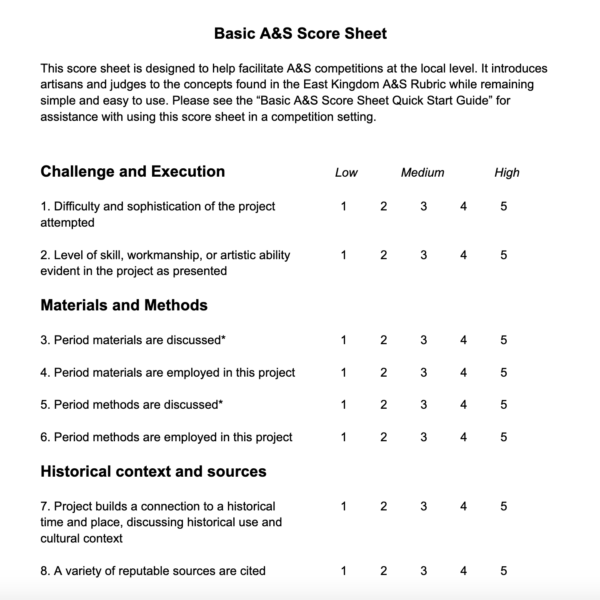
Basic A&S Score Sheet Ready for Beta Testing

Over the past few months, the MoAS team has been working on creating a resource intended to help local groups run A&S competitions: The Basic A&S Score Sheet. This one-page resource introduces the concepts found in the East Kingdom Rubric on a less intense, more pared-down scale to make it approachable for beginner artisans, while maintaining the core components to allow more experienced artisans to enjoy using it as well. The scoresheet comes with a one-page “quickstart guide” to help artisans and judges understand quickly how to use the elements of this scoresheet.

The MoAS team has finished our final round of editing, and the scoresheet is now available for beta testing! Use the link below to find the beta-testing version of the A&S scoresheet: 

https://drive.google.com/file/d/1Ar_aXgBvRTP3PnpvI7cST2e9igJzxgni/view?usp=sharing

If you use this for your local group’s competition, please let the Kingdom MoAS minister know how it goes! All commentary, both positive and critical, is very helpful as we work to refine this resource. You can contact the KMoAS at moas@eastkingdom.org.

In service,

Amalie
EK MoAS

Proudly powered by WordPress | Theme: Baskerville 2 by Anders Noren.

Up ↑