Sabine di Sandra — Chaucer Meets Black Lance

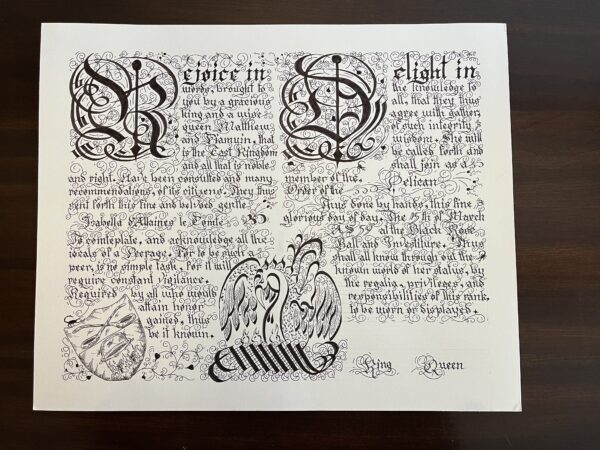
This piece is four fully illuminated and calligraphed 11”x14” scrolls. It was created in the style of an early 15th century English manuscript of Geoffrey Chaucer’s Canterbury Tales known as the Ellesmere Chaucer. I created a specialized ductus from the calligraphy in the manuscript for this project. I also researched the pigments and materials used for the artwork, and emulated them with safer and more practical materials. This work was not intended to be a facsimile, but I was meticulous about the details when possible. 

The words used for this project are “Black Lance, the Blue Tyger Legion of Pennsic XLIX” – a collaborative tale by Lord Brogain O’Riain, Sir Klaus Winterhalter, Imperator Allaricus Xirinius Dominus, Lady Caitlin FitzGerald, and Sir Donnan FtizGerald recounting a fateful Pennsic War where the East Kingdom’s Black Lance heavy fighting unit found glory. This project is dedicated to them and to all members of Black Lance. 

The guiding star of my SCA journey has always been my communities and their stories. I love hearing epic tales woven from our events and gatherings, and I think they are what gives the SCA a large part of its magic. My ultimate goal for this piece was not only to help this particular story live on, but also to encourage these stories to be written, told, and embellished forevermore.

Chaucer Meets Black Lance was first displayed at St. Eligius, where it won overall. It now lives in the Rag and Bone Meadery near Mullica Hill, NJ. You can read the full St. Eligius write-up on Sabine’s SCA art blog.

Additional Links:

The full St. Eligius write-up and pictures of each page can be found on my blog: https://sabinedisandra.wixsite.com/art-with-sabine/post/st-eligius-2025-chaucer-meets-black-lance

Emeline La Chauciere — Reconstructing Serlio’s Scene: Materials and Methods of the Renaissance Backdrop

For this project, I recreated a 16th-century Italian theatrical backdrop using historically documented scenic-art techniques. Drawing on the writings of Serlio, Vasari, Cennini, and Sabbatini, I produced hand-made paintbrushes using squirrel hair, created distemper paints from pigments and animal-glue size, and executed a scaled drawing of Serlio’s comic scene. This drawing was transferred to sized linen canvas through the spolvero (pouncing) method — a process involving gridding, pricking, and dusting charcoal through perforations to reproduce an image at a larger scale. The result is a historically inspired theatrical backdrop that reflects the look, materials, and workflow of an Italian Renaissance scenic workshop.

I completed this project for the St. Eligius Arts & Sciences event in the Barony of Dragonship Haven (East Kingdom) in November 2025, where it was displayed and judged. St. Eligius emphasizes research, craft, and clear explanation of process, making it an ideal venue for a technically and historically rooted exploration of theatrical art. My work was displayed alongside my handmade brushes, pigment tests, and preparatory drawings, allowing viewers to follow the entire journey from raw material to finished artwork.

I undertook this project because I wanted to explore the deep theatrical heritage of the medieval and Renaissance world– a lineage that directly informs modern scenic design. As a theatrical scenic designer and educator in my modern life, I’ve always been fascinated by how early artists developed systems for creating perspective scenery, transferring images, and mixing paint. Their processes, many of which survive in treatises and workshop manuals, still echo in contemporary scenic studios today. This project allowed me to honor that continuity, to learn from the techniques of my artistic ancestors, and to bring a bit of Renaissance stage magic into the Society for Creative Anachronism. I also intend to paint this backdrop as part of the decor for Settmour Swamp’s upcoming immersive Venetian Carnevale Event. 

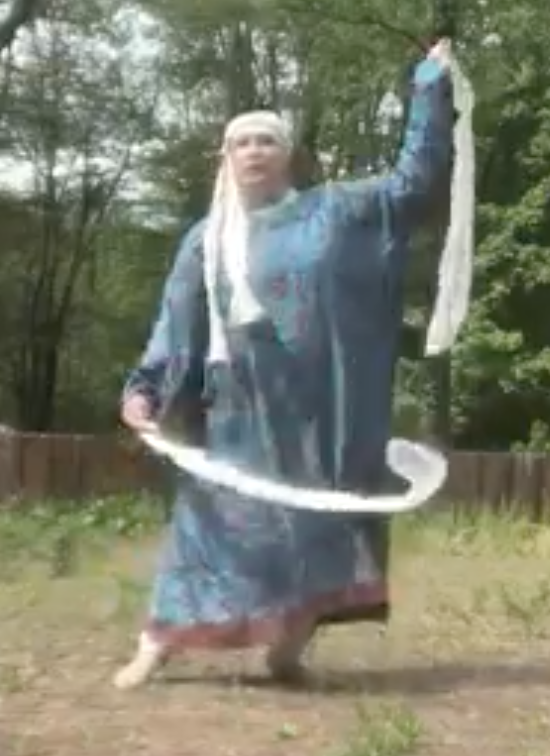
Maria von Ossenheim — Marie,  Freiin von Ozenheym, 1379 – 1436

My name in the society is Baronin Maria Erika von Ossenheim. For the purpose of Artifacts of Life, my name would have been Marie, Freiin von Ozenheym born 1379 and died 1436. Maria was not a popular name until much later; however there are a few examples of Marie, another form of the biblical name Mary. Erika is not a period name and for that reason will not be used in this context. Upon further research Ossemheim was not used until at least a couple of centuries later than my persona time period. That would have been correct for my late mother’s persona’s time period of the mid 16th century based upon the exact town in Germany where she was modernly born. The title of Baroness does not directly translate into 14th century Germany. The closest I could find was Freiin which directly translates to Free Lady and was considered to be a person who was titled or landed and was above a knight or untitled noble, but below the rank of Countess. As someone that was born as a baroness the title Freiin is correct, rather than Freifrau, married into the title. I  prefer the title of Baronin which is later period and also used in modern terms, to me it reads closer to the title Baroness. During WWI century German titles were no longer used and any family titles were remade as part of the family name. Thank you to the nobles that kept good records.

     While the name research is not an artifact, it is at the heart of the project and that of the persona, therefore the artifacts of that life are born from, and so Marie, Freiin von Ozenheym lived and died. Marie is a baroness of Ozenheym and for the purposes of this project is the titled noble of that area. Maria, my SCA persona is the only daughter of a Silk Road merchant and a Baroness due to her mother and her being sole heir, female lineage. As such she had the means and the right to own and wear fine garments. German sumptuary laws were not sternly written about in this earlier time period, but it was feasible for someone of wealth and nobility to have items of silk, fur, and other fineries

     The artifacts chosen are ones that are either shown in the effigy or used to create the pieces in the effigy.  All would have been found during the lifetime of Marie and are created by my hand. There are additional items displayed to allow for a better visual representation, but are either not made by my hand, made out of the allotted three year creation, or purchased as part of my persona collection. Items that are presented as artifacts will be pointed out during the presentation. Each artifact will have a verbal description of how it links to the effigy as a whole. 

I present an effigy of my life with the following artifacts:

  • Artifact 1- A sleeveless chemise
  • Artifact 2- Fingerloop cordage 
  • Artifact 3 – Bag
  • Artifact 4- Striped dress
  • Artifact 5- Brigetta cap
  • Artifact 6- Cloak
  • Artifact 7- Lucet and cord
  • Artifact 8- Frilled veil

Picture by Brenden Crane (Background blurred by Erika Falle)- Marie,  Freiin von Ozenheym, 1379 – 1436

Sulicena filia Vassurae — Iron Age Ceramic Tools and Pottery

The artifacts that inspired this project were found during the excavation of the Glastonbury Lake Village, a pre-Roman Iron Age community located in the Somerset Levels in southwestern England. The settlement was probably first established between 250-160 BCE (Minnitt & Coles and Marshall et al. 2020), and the main phase of occupation lasted for perhaps 75-135 years, before a gradual decline prior to abandonment sometime between 100 and 50 BCE, most likely due to flooding caused by rising water levels (Minnitt & Coles, 15-19). The village was built on an ever settling human-made island of clay, rubble, and bracken packed onto a foundation of brushwood and timber, all resting on the peat, in swampy wetlands in a bend of the River Brue (Cunliffe, 269).

The clay tools are made from deer antler tines. Both red deer and roe deer antlers were used for tools at the GLV. Antlers naturally shed by deer in the winter were used much more frequently than antlers from hunted animals. I made these tools with locally procured white tail deer antlers. I cut sections of antler with a jeweler’s saw, and used a small metal file to make a groove in the end of one tine to make the double line tool (H307). For the circle stamps (H19 and H75) I soaked the cut antler pieces in room temperature water for about 24 hours. The next day I used small metal woodworking gouges to carve out the ends of the soaked antler pieces until only the edge of the circle remained (Wold). Tools like these were used to mark the surface of damp clay. H307 is used to make a double line by drawing the tool along the surface of the clay. H19 and H75 are used to stamp two sizes of circle. 

The pottery found in the GLV is handbuilt, rather than made using a wheel. A flat disc forms the bottom of the pot, then horizontal bands or coils of clay are layered on top of the edge of the disc to form the walls. Additional clay is rubbed into the seams between the bands and smoothed over. The pots are smoothed and burnished further when the clay has dried to leather hardness (Bulleid 1917, 500-1). I made a pot in the style of P106 using this technique. When the wet clay of the newly made pot started approaching leather hardness I began smoothing the body of the pot with my fingers, then applied the design with the antler tools and a stylus. I refined the design as the surface continued to harden, and burnished the pot with a smooth bone tool. No kilns and very few “wasters” (pieces of pots broken in firing) have been found in the GLV. This would indicate that even utilitarian, undecorated pottery is made off site and transported to the village. This work site is probably not far away, due to the number of the pots found, and that the main source of local clay is near Shepton Mallet, about 10 miles to the east (Minnitt & Coles, 26-7).

Additional Links: 

These objects are part of my entry for Artifacts of a Life VI. The rest, including references, can be seen here: https://docs.google.com/document/d/1bJdjULN5P9bFb04tVnKZmcAliffqq2u6YB68MDJ-L9A/edit?usp=sharing 

A short film showing the fabrication of a pot in this style and the use of these antler tools can be found here:

Aradyn Ghyoot — A Page in 5 Parts

In 2018 I embarked on a project to understand how vellum worked as a ground, how the materials I was already very familiar with worked on the most used ground in period, and how my process would have to change to work with this new material. I chose a source with a most excellent carpet page, and one that would be easy to do in parts: Add MS 28162, The Somme le Roi, a moral compendium compiled in 1279 for King Philip III of France. A beautiful French manuscript with heavy gold work, this manuscript features multiple pages of 4 panel depictions of the Virtues.

The finished project will be the Vellum Dragon and four separate images, each a “complete” panel as though the panels were individual images. This project is the learning section for the final project, which will be a 4 panel “missing page” from MS 28162 – 4 virtues done in the style of Somme le Roi with original artwork.

So far I have completed the Vellum Test Piece, Panel One, and Panel Two. Panel Three was started in November of 2025 and I plan to have that further along for Kingdom A&S in March where I hope to display. As I move into Panel Three, the imagery will be more secular than Panels One and Two. While my goal with the first two Panels was to determine technique, my goal with the next two Panels will be to apply that technique effectively and move toward original artwork. I will still be experimenting with the gold, but I now plan to do my gold experiment on a smaller scrap piece of vellum. I will have those tests on display (both online and in person) as they’re completed. Vellum is pricey, and I have a couple theories to test before I start back on my sketched Panel. 

More information can be found at the project link above, along with my contact information. 

Proudly powered by WordPress | Theme: Baskerville 2 by Anders Noren.

Up ↑