Name: Cecilia Pisano
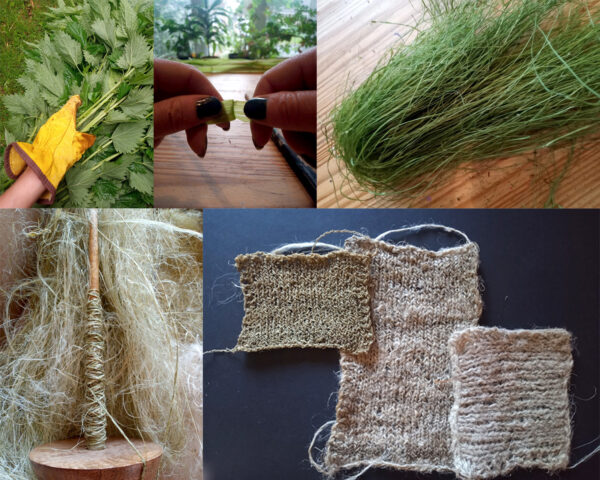
Here are some experiments in extracting, spinning and using nettle fibers to obtain
fabric.
There is little documentation of the use of nettle fiber in the Middle Ages,
probably because few textile fragments have survived due to conservation
difficulties and many fragments studied could be attributed to linen since its
cultivation is recognized and studied throughout Europe.
It’s quite sure that wherever nettle grows, it has been used for its fibers, even if the
extraction process is more laborious than that of, say, flax.
Nevertheless we find traces of the word “nettle fiber” (nettylcloth) both in
Latham’s List of medieval Latin words, which associates the word Urtica (from
Urtica dioica) with the term nettle cloth and the date of 1391, and in De
Vegatabilibus et Plantis by Albertus Magnus (1193-1280), the greatest scholar of
the Middle Ages who found clothing made with this fiber uncomfortable and
irritating to the skin.
Picking nettle is not without its drawbacks; its stinging hairs inject, among other
things, formic acid and histamine, and slight contact can cause painful blisters on
the skin. The process to obtain an acceptable fiber is quite long (I separate the
fibers one by one, delicately to preserve their length which can reach 16 inches)
but the results are encouraging.
All I have to do now is find a way to make the resulting fabrics less rough than
these, whose feel is reminiscent of coarse wool.
On the other hand, flexibility is there, at least in my samples knitted with
stockinette stitch.
Next step? Testing vegetable dyes on my samples And this is just the beginning of
a long and fascinating journey!